Two languages, more ways to understand the world: The benefits of bilingual education in Kindergarten
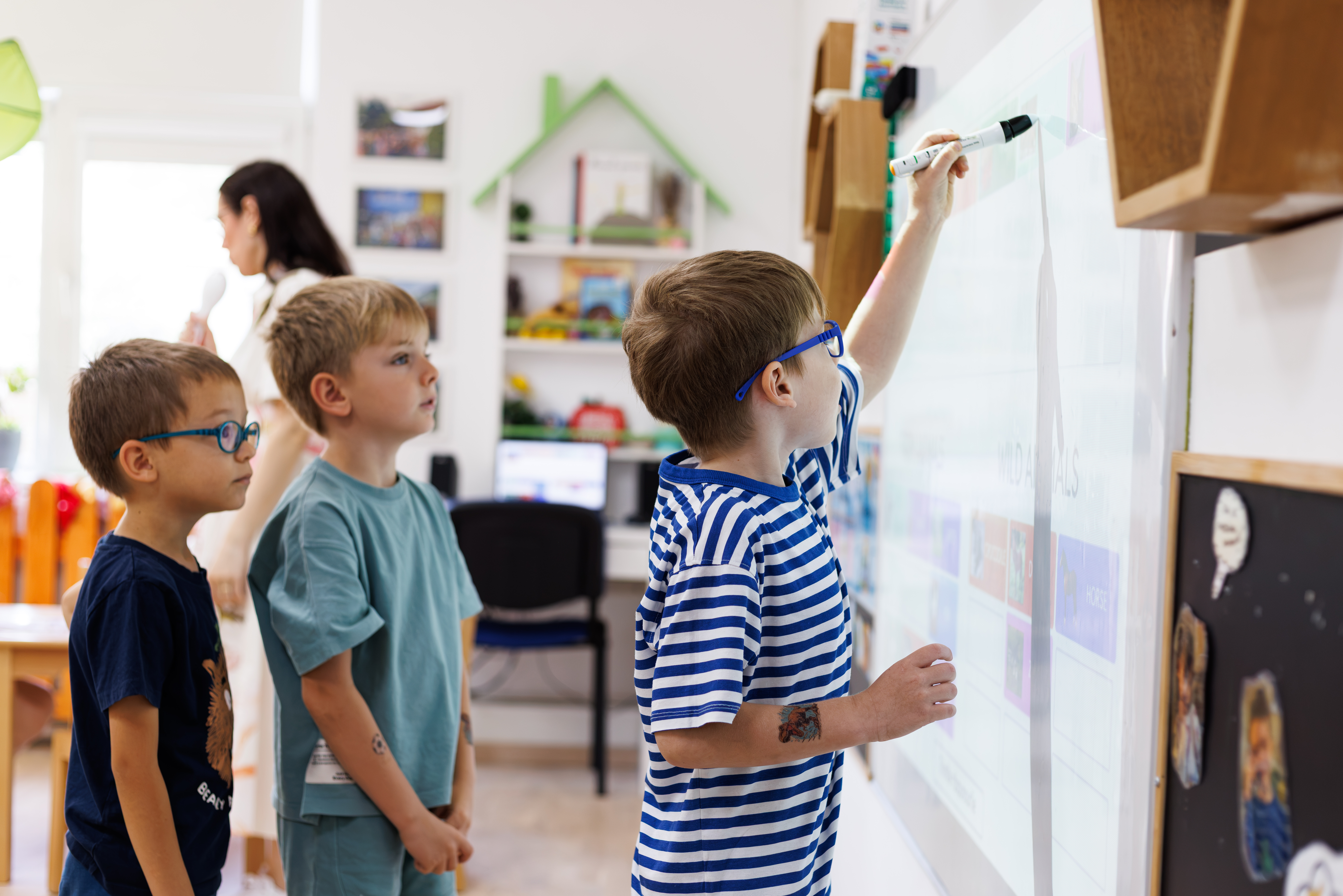
For many families in Bucharest, choosing a kindergarten is no longer only about location, facilities or the daily schedule. Language has become an equally important consideration.
International and mixed-nationality families may be looking for an environment in which their children can continue learning in English while gradually becoming familiar with Romanian. Romanian families, meanwhile, increasingly want their children to develop genuine confidence in English from an early age, not simply by attending several language classes each week, but by using the language naturally throughout the day.
This is where bilingual and English-immersion education can make a meaningful difference.
Young children learn languages through life, not translation
Preschool children do not learn a new language in the same way adults usually do. They acquire it through relationships, routines, stories, movement, play and repeated meaningful experiences.
A child may first understand the English phrase "Let's wash our hands" because it is heard every day before lunch. Later, the child begins to use the same words independently. During play, expressions such as "Can I have this?", "Let's build a house" or "It's my turn" gradually become part of the child's natural communication.
This type of learning is different from memorising vocabulary lists or translating isolated words. Language is connected to an action, an emotion, an object or a relationship. As a result, children understand not only what a word means, but also when and why it is used.
Exposure to two languages in early childhood does not inherently confuse children. Research shows that young children are able to distinguish between the languages they hear and can learn the sounds and patterns of both. Their vocabulary may sometimes be distributed between the two languages, knowing certain words in one language and others in the second, but their total language knowledge should be considered across both.
Communication before perfection
One of the most valuable outcomes of early bilingual education is not flawless pronunciation or an impressive vocabulary at the age of four. It is the confidence to communicate.
In a well-designed bilingual environment, children are not constantly corrected or placed under pressure to produce the "right" answer. They are encouraged to participate, express a need, share an idea, ask a question and join a game.
At first, a child may respond through gestures, facial expressions or a combination of languages. This is a natural stage of language development. With consistent exposure and sensitive support from teachers, comprehension usually develops before speaking fluency.
Over time, children begin to experiment with the new language. They repeat familiar phrases, combine words, initiate conversations and eventually communicate with increasing independence.
This confidence is particularly important for children growing up in international communities. Language becomes more than an academic skill, it becomes a means of building friendships, adapting to new environments and feeling that they belong.
Bilingual education can encourage flexible thinking
Moving between two languages requires children to notice context: who they are speaking to, which words are appropriate and how the same idea can be expressed differently.
Researchers continue to debate whether bilingualism creates a universal cognitive advantage, and the evidence should not be overstated. Some studies, however, suggest that bilingual experience may support areas such as attentional control, inhibition and cognitive flexibility, particularly when children use both languages regularly and meaningfully. Other reviews have found mixed results, indicating that benefits depend on factors such as proficiency, frequency of use and the child's wider educational environment.
The clearest everyday benefit can often be observed without a test: bilingual children learn that there may be more than one way to name, explain or understand something.
This awareness can help nurture openness, adaptability and curiosity about people whose experiences differ from their own.
The quality of the educational experience still matters most
Simply exposing children to English does not automatically create a strong bilingual programme.
The quality of early education continues to depend on the relationships children build with adults, the relevance of the learning experiences, the teachers' understanding of child development and the emotional safety of the environment.
Young children acquire language most effectively when they feel secure enough to take risks. They need teachers who notice when they are ready to speak, when they need visual support, when they require repetition and when they understand more than they can yet express.
They also need opportunities to use language for a genuine purpose.
At kindergarten, these opportunities arise through role play, stories, music, construction, outdoor exploration, creative projects, scientific investigation and everyday problem-solving. A child who is designing a bridge with classmates has a real reason to discuss size, shape, balance and possible solutions. A child investigating insects in the garden has a reason to observe, describe, compare and ask questions.
Language learning becomes stronger because it is part of a broader learning experience.
Two language pathways at Genesis College
At Genesis College, families can choose between two Early Years pathways, depending on the linguistic environment they want for their child.
The standard bilingual programme is designed for families who value education in both Romanian and English. Children develop their communication skills in the two languages within a learning environment shaped by play, inquiry and meaningful daily interaction.
English is integrated into the children's experience rather than treated only as an isolated subject. At the same time, Romanian remains an important language for communication, relationships and learning. This pathway may be particularly suitable for Romanian families seeking strong, natural exposure to English while maintaining a solid connection to the child's first language, as well as for international families who want their children to gradually become comfortable using Romanian.
As a novelty, beginning with the 2026-2027 school year, Genesis College is introducing the English Immersion Programme, created for families who want their child's entire educational experience to unfold in English.
In this programme, English is the language through which children learn, play, build relationships, investigate ideas and understand the world. It is not simply taught; it is lived throughout the kindergarten day.
The programme follows the International Baccalaureate Primary Years Programme framework and is delivered by a dedicated team of educators with experience in IB PYP implementation and English-language learning environments.
Both pathways share the same educational philosophy. Learning is personalised around each child's interests, developmental stage and individual rhythm. Play is treated as a central form of learning, while care, emotional wellbeing and secure relationships provide the foundation from which children can explore with confidence.
"For us, bilingual education is not about asking children to perform in a second language before they are ready. It is about creating an environment in which language becomes useful, meaningful and connected to real experiences. When children feel safe, cared for and genuinely interested in what they are doing, they begin to communicate naturally. Our responsibility is to offer them both the confidence and the opportunities to do so." said Elena Mănescu, Kindergarten Principal at Genesis College.
Learning beyond the classroom
Drawing on 26 years of educational excellence, Genesis College has carefully designed learning environments that reflect decades of expertise in supporting children's holistic development, ensuring every space is purposefully created to inspire curiosity, exploration and meaningful learning.
The physical environment also plays an important role in the Genesis Early Years experience.
Children have access to a generous 5,000-square-metre outdoor area, offering space for movement, free play, nature exploration and learning outside the classroom. Outdoor experiences provide rich opportunities for language development: children negotiate games, describe discoveries, collaborate on projects and communicate in spontaneous, authentic situations.
The campus also includes the Genesis Discovery Centre, a STEAM learning space created specifically for preschool children.
Its areas, including the Tech & Construction Lab, Nature & Art Studio, Journey of Discovery Hallway and Soft Play Room, invite children to build, experiment, create, collaborate and move. In both the bilingual and English-immersion pathways, these experiences create natural contexts in which children use language to develop ideas rather than merely demonstrate vocabulary.
Which programme is right for each family?
There is no single language pathway that suits every child.
A bilingual programme may be the right choice for families who want children to develop naturally in both Romanian and English and to feel equally connected to the local and international dimensions of their community.
An English-immersion programme may better suit international families, children preparing for an English-language school pathway or Romanian families seeking an educational environment conducted entirely in English.
Parents should consider the languages already used at home, the child's previous exposure, the family's longer-term educational plans and, importantly, the type of environment in which the child feels most secure.
Whichever pathway they choose, the goal should extend beyond producing children who can speak another language. High-quality early bilingual education can help children become confident communicators, attentive listeners and curious learners, children who understand from an early age that the world can be described in more than one language and viewed from more than one perspective.
*This is partner content. ...
이 뉴스, 어떠셨어요?
탭 한 번으로 반응 · 로그인 불필요