Inside Bibi's pivotal White House meeting with Trump
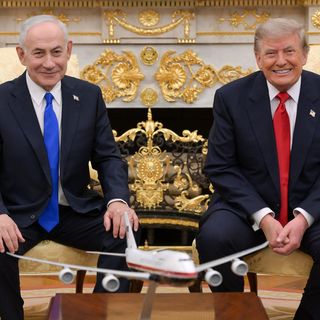
Israeli Prime Minister Benjamin Netanyahu expressed skepticism during his meeting with President Trump about the chance of a deal with Iran and discussed increasing economic pressure on Iran "through kinetic and non-kinetic means," a senior Israeli official said in a briefing with reporters.
Why it matters: Tuesday's meeting was the first between Netanyahu and Trump since the start of the war on Feb. 28. It came as Trump is still trying to reach a deal with Iran but also considering a return to major combat operations.
Several hours after the sitdown, Iran launched a missile attack on an American base in Jordan for the first time since Trump paused U.S. strikes in Iran on Friday.
Trump vowed a serious response during an interview with Fox News Wednesday. Iran's surprise attack could push the president toward a full-scale escalation.
The Israeli official said Netanyahu is awaiting Trump's decision but made it clear to him that if Iran attacks Israel, the Israeli response will be immediate and powerful.
Inside the room: Iran was the main focus of the 90-minute conversation.
The Israeli official said they discussed three options Trump is considering for next steps:
1. Reaching a deal with Iran. Trump envoys Steve Witkoff and Jared Kushner are still negotiating with the Iranians, though at the moment the gaps still seem wide. The Israeli official said Netanyahu told Trump he is skeptical an agreement with the Iranians can be struck.
2. Continuing the naval blockade on Iran while increasing economic pressure.
3. Resuming and intensifying military strikes.
"We discussed all of those options at length and very candidly. Not as an attempt to promote one option over another, but to examine what the best outcome would be from each. That's what the conversation was about," the official said.
Zoom in: The Israeli official said Trump expressed concern about the war's impact on energy markets and the global economy.
Netanyahu told Trump the Iranian regime is mainly trying to use the only leverage it has left — the Strait of Hormuz — to force U.S. concessions.
Netanyahu didn't disregard Trump's concerns but told him there are ways to continue increasing pressure on Iran's economy, which is already under severe strain, the Israeli official said.
"We discussed increasing the economic pressure through both kinetic and non-kinetic means. We talked about the possibility of continuing the blockade in order to pressure Iran," the Israeli official said.
The Israeli official said there is a debate inside the Iranian leadership between those who are very concerned about an economic collapse and the more radical elements that think as long as they control the weapons and can support the regime's base of supporters, they don't have a problem.
"They're having fuel supply problems, long lines at gas stations, diesel shortages. There are small protests because the public is very frustrated. The regime is very worried about that. It's concerned that people will rise up over the economic situation," the Israeli official added.
Behind the scenes: The Israeli official said Iran's supreme leader, Mojtaba Khamenei, takes a very negative line "about everything," but it is unclear whether his alleged orders really come from him.
"He is alive, but nobody can testify that they've actually seen him. He told his people not to do anything without getting his approval, and even once allegedly got angry when they didn't," the Israeli official claimed.
Zoom out: Netanyahu presented Trump with a map of Syria that showed that the areas Turkey controls in Syria "are 50 times larger" than the areas Israel occupies, the Israeli official said.
The Israeli official claimed Turkey controls 5% of Syria while Israel controls 0.1%.
Unlike the Israeli occupation in southern Syria, Turkish military presence in northern Syria is taking place today at the consent and invitation of the Syrian government, a U.S. official said.
The Israeli official said Netanyahu told Trump Israel will maintain its presence in the "buffer zone" in southern Syria as long as there is a threat from "jihadist groups."
"Netanyahu wanted to show this to Trump because sometimes he forms certain opinions based on inaccurate information that some people give him. If you don't find a way to change his opinion early on, it becomes fixed. So we wanted to present the facts, visually if possible," the Israeli official said.
The Israeli official said Netanyahu also discussed with Trump the U.S.-Saudi nuclear deal. Trump told Netanyahu he sees the deal in the context of Saudi Arabia normalizing relations with Israel.
"We'll have something to say on the nuclear issue if we see real progress," the Israeli official said.
The big picture: The Israeli official said Netanyahu told Trump, Vice President Vance and Witkoff that he is serious about reducing U.S. military aid to Israel to zero within 10 years. He stressed that he wanted to move forward with negotiating a memorandum of understanding about it.
The Israeli official said Trump and his team said they are getting feedback from Republicans who worry they'll be accused of being anti-Israel because they support phasing out aid.
Netanyahu told them he's going to lead the effort publicly because he wants to achieve defense independence for Israel.
"We're talking about a 10-year process. We're open to proposals, maybe it can happen faster," the Israeli official said.
The official even said that Netanyahu instructed Israel's defense sector to work on developing a modern fighter jet within a decade so that the country's air force will remain strong even if the U.S. stops supplying F-35s and other sophisticated jets.
The official said Netanyahu does not want Israel to be dependent "on the goodwill of the U.S. Congress" because he sees the political winds on military aid turning negative among both parties.
Netanyahu believes Israel's economic situation allows it to phase out U.S. military aid. The Israeli official said Netanyahu is proposing that a new MOU include $16 billion in direct U.S. military aid, in addition to $5-10 billion in support for Israel's development of missile defense systems.
On top of that, Netanyahu is proposing the creation of a $16 billion joint fund for research and development of new weapons systems. ...
이 뉴스, 어떠셨어요?
탭 한 번으로 반응 · 로그인 불필요