The World Cup Story (Almost) No One Told
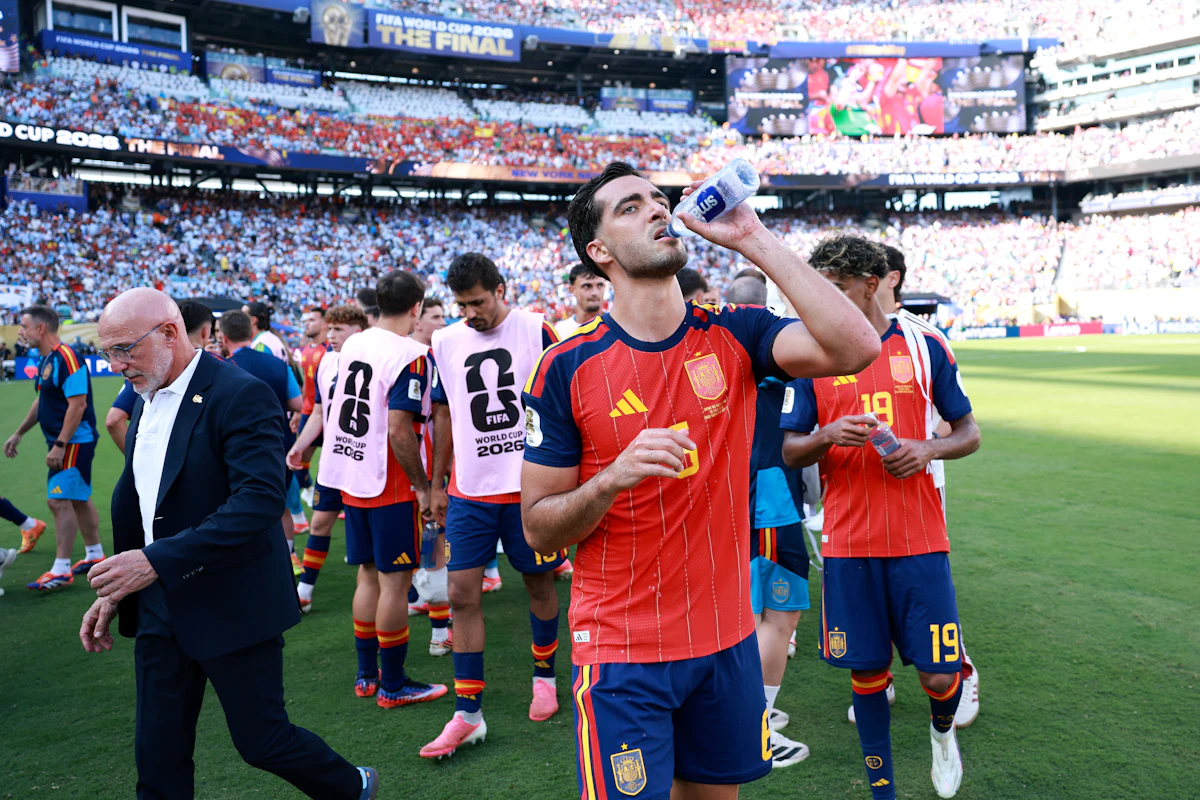
The 2026 World Cup will be remembered in part for bringing the term hydration break into the global football lexicon. For the first time in the Cup’s 96-year history, matches were interrupted midway through each half so players could hydrate and rest. Many fans disliked the breaks, complaining they were simply an excuse to show more TV commercials during what is, after all, the most watched sporting event on earth.
That suspicion is not entirely wrong, but it confuses outcome with cause. There are good reasons, grounded in science and articulated by the international football players’ union, for hydration breaks. But almost none of the U.S. media coverage of the 2026 World Cup, with one outstanding exception, highlighted those reasons, much less explained them.
The exception was Telemundo, the Spanish-language TV network whose news division has been a leader in climate coverage. On July 3, journalist Vanessa Hauc, the host of Telemundo’s weekly environment program Planeta Tierra, appeared on the broadcast of the much-anticipated match between the defending champions, Argentina, and everyone’s favorite underdogs, Cape Verde. At the time, hundreds of millions of Americans were under extreme heat warnings from a “heat dome” that scientists said would have been “virtually impossible” without climate change.
Andrés Cantor, the Telemundo announcer famous for his prolonged shout of “Gooooooooal” whenever a team scores, introduced Hauc, saying that “although the hydration breaks are highly controversial, there’s a deeper reason for them.” Hauc reported that the game-time temperature of 89 degrees Fahrenheit in Miami “can feel closer to 101” on the field, when humidity and the sun’s rays are factored in. “That’s why hydration breaks aren’t just a precaution, they’re a safety measure in an increasingly hotter world,” she said, adding that the world is hotter mainly because of “the way we produce energy, primarily by burning oil, coal, and natural gas.”
That evening, Colombia faced Ghana in Kansas City, where the weather was equally oppressive: 88 degrees with 70 percent humidity. Hauc reported that such conditions “make it harder for the body to cool itself, causing core body temperature to rise and increasing the risk of exhaustion, dehydration, and even heat stroke” for the players. She added, “Behind all of this is a larger reality: Heat waves are becoming more frequent, more intense, and longer lasting because of the climate crisis, driven primarily by the burning of fossil fuels.”
In interventions of only 42 and 52 seconds, respectively, Hauc delivered a master class in climate reporting. She humanized the story by talking about the scorching heat that players and viewers were experiencing. She localized the story, in emotional terms, by describing the impacts on the sport so many people love. And she “solution-ized” the story by naming the cause of the problem—the burning of oil, gas, and coal—and advising that “as the planet continues to warm, the game of soccer and sports more broadly will have to adapt.”
FIFPRO, the players’ union, began making that argument well before the 2026 World Cup, spurred by the increasingly harsh playing conditions its members had been facing. The heat and humidity were so brutal at last summer’s FIFA Club World Cup tournament that one referee fainted on the field. Enzo Fernando, the Argentine whose Chelsea club won that tournament (which was played in the same stadium in New Jersey that hosted the 2026 World Cup final where Fernando’s national team lost to Spain), said at the time, “I had to lie down on the ground because I was really dizzy. Playing in this temperature is very dangerous.”
FIFPRO commissioned a scientific study examining what such temperatures meant for players’ health and performance, and it shared the study’s results with FIFA. The union recommended introducing breaks in play if the “wet bulb global temperature”—which combines temperature and humidity levels—reached 26 degrees Celsius (roughly 79 degrees Fahrenheit) and suspending play at 28 degrees Celsius. FIFA disagreed, wanting cooling breaks only at 32 degrees Celsius (roughly 90 degrees Fahrenheit). The compromise appears to have been adding hydration breaks during the 2026 World Cup.
This explanation by no means quiets suspicions about FIFA’s appetite for additional TV money. FIFA head Gianni Infantino denied such accusations, saying that hydration breaks resulted in “no additional revenue for FIFA, as all commercial agreements were signed well in advance.” That is technically correct but utterly incomplete: The six extra minutes of TV commercials made possible by hydration breaks clearly increase the value of the TV contracts FIFA can sell for World Cups in 2030 and beyond.
To be clear, Telemundo was not above making extra money from hydration breaks; ads wrapped around the left and bottom edges of the screen while Hauc or her sports colleagues offered their commentary. But Telemundo, meanwhile, made sure to help its viewers understand why these hydration breaks were happening in the first place.
That was both journalistically responsible and commercially shrewd. A study released last month by the Yale Program on Climate Change Communication found that 74 percent of Americans, roughly three out of four, say “they are interested in news stories about global warming.” Other polling has documented that Latinos have long been even more concerned about climate change than the general population.
Hauc and Telemundo’s example shows what the rest of the media could have done to help audiences understand why the 2026 World Cup was played differently than any other—and why football is not the only sport changing its procedures in the face of global warming. As Hauc reported, the governing body of professional tennis now allows players to request a cooling break when the wet bulb global temperature exceeds 30 degrees Celsius (roughly 86 degrees Fahrenheit). The Los Angeles Marathon this year allowed runners to officially finish the race at mile 18 instead of mile 26 due to extreme heat.
And these measures are only the beginning, for the physics is unequivocal: Global temperatures will continue to climb until the burning of fossil fuels is phased out. And the longer we wait, the greater the paradox confronting us: As hot as the summer of 2026 is, it will be remembered as one of the cooler summers of our lives.
This article is published as part of the global journalism collaboration Covering Climate Now. ...
이 뉴스, 어떠셨어요?
탭 한 번으로 반응 · 로그인 불필요