Lindsey Graham Embodied the Republican Party’s Authoritarian Drift
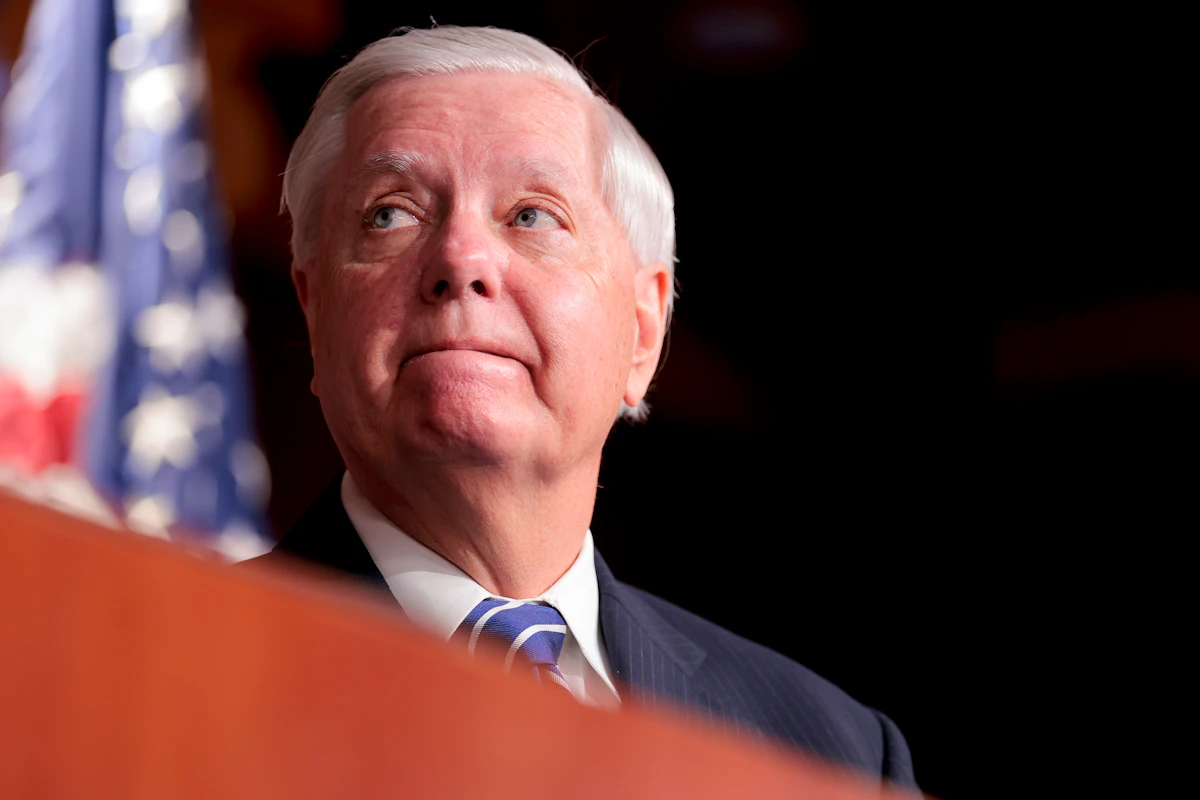
The best obituary of Lindsey Graham appeared not after his death on Saturday but exactly a year before the event that would define the final stage of his career. On January 6, 2020, Rolling Stone published a profile of Graham by Mark Binelli that catalogued the South Carolina senator’s path from bipartisan dealmaker to MAGA disciple. It included this quote from Steve Schmidt, who managed John McCain’s 2008 presidential campaign back when Graham was the maverick senator’s sidekick:
People try to analyze Lindsey through the prism of the manifest inconsistencies that exist between things that he used to believe and what he’s doing now. The way to understand him is to look at what’s consistent. And essentially what he is in American politics is what, in the aquatic world, would be a pilot fish: a smaller fish that hovers about a larger predator, like a shark, living off of its detritus. That’s Lindsey. And when he swam around the McCain shark, broadly viewed as a virtuous and good shark, Lindsey took on the patina of virtue. But wherever the apex shark is, you find the Lindsey fish hovering about, and Trump’s the newest shark in the sea. Lindsey has a real draw to power—but he’s found it unattainable on his own merits.
There have been many obituaries of Graham over the past few days. Some, especially the one that appeared on NBC’s Meet the Press—where Graham was scheduled to appear on Sunday—treated him as the epitome of back-slapping decorum in the Senate. But the good ones, like those published by Josh Marshall and our own Michael Tomasky, focus on the senator as a pilot fish and a bottom feeder. The real story of Graham’s career wasn’t an evolution from bipartisan dealmaker to fascist enabler; it was a consistent attraction to those who served power.
Graham was never a driver of conservative or right-wing politics, nor did he ever come close to attaining real power. (His lone presidential campaign in 2016 ended two months before the primary began.) Graham was a cynic and an opportunist. But his status as the Republican Party’s preeminent bootlicker also makes him more illustrative of the authoritarian drift of the GOP over the last 30 years than perhaps any other politician. And for all the fond remembrances of Graham’s time at McCain’s side, the party that he represented was never one that was fond of dealmaking or compromise.
Graham was first elected to Congress during the Republican Revolution in 1994. Running with the backing of South Carolina Senator Strom Thurmond, Graham won a House seat that had been held by longtime Democratic incumbent Butler Derrick, who decided not to run for reelection in an increasingly red district. Though Graham was less sharp-toothed than many of the other House Republicans who swept into power amid Newt Gingrich’s “Contract for America,” he was still sharply partisan. A longtime attorney, he served as an impeachment manager against Bill Clinton over the president’s affair with Monica Lewinsky and led the push to prove—correctly—that he had lied.
But it wasn’t until Graham entered the Senate in 2003 that he began to emerge as a national figure—largely due to his alliance with John McCain. A former judge advocate general in the Air Force, Graham voted for President George W. Bush’s Iraq War soon after taking office. In the years to come, as one of the “Three Amigos”—a group of neoconservative senators that included McCain and Joe Lieberman, the 2000 Democratic vice presidential nominee—he would consistently use his voice to back using American military power abroad. It’s fitting that Graham may have died because he insisted on using his voice to back intervention: He reportedly declined to seek medical attention on Saturday evening because he wanted to be able to go on Meet the Press on Sunday to discuss a recent trip to Ukraine. “I can’t die now,” he told the person who urged him to see a doctor. “I still need to do the Russia sanctions, get Iran sorted out, and do Israeli-Saudi normalization.”
Much has understandably been made about Graham’s transformation after McCain’s death in 2018. It’s true that Graham was a fierce critic of Donald Trump in 2015, when the two were competing for the Republican nomination for president—and continued to condemn Trump after withdrawing from the race in December. Over the course of the 2016 election, Graham called him a “kook,” a “jackass,” and a “race-baiting xenophobic religious bigot.” He said the Republican Party would be “destroyed” if he was elected. And then, soon after McCain’s death in 2018, Graham became one of Trump’s best and most trusted allies in the Senate.
There is some disagreement about whether that marked a “transformation” for Graham and a betrayal of his principles, or if it was simply a continuation of his long career as a “pilot fish.” In many ways, that debate mirrors one about the broader shift of the Republican Party in the Trump era—if its MAGA-fication marks a sharp break from its past or is simply an evolution (or rather, devolution) that can be traced back to Barry Goldwater, if not earlier.
Graham’s career was a strong argument for the latter interpretation. A Zelig-like figure, he was never the most powerful or influential Republican over the course of his 30-plus years in Congress, but he was there every step of the way as the party drifted from the hell-raising of the Gingrich years to the interventionist paranoia of the post-9/11 period to the obstructionist push during Obama’s presidency to the present authoritarian moment. And he was, at nearly every turn, a consummate Republican. ...
이 뉴스, 어떠셨어요?
탭 한 번으로 반응 · 로그인 불필요