ChatGPT’s Daring Escape Forces Dems to Pick a Path on AI Legislation
Editor’s Note: Welcome to The TNR Blue Book. It’s our new daily newsletter that covers Congress and much more, but with a distinctly TNR twist: Our focus will be strictly on Democrats, liberal and progressive groups, and the fight to take back power and save democracy. Every morning, you’ll get a rundown of late-breaking news, what Democrats on Capitol Hill are thinking, quick hits on what you need to know nationally, the latest on what’s coming out of the think tanks and activist groups, short interviews with progressive newsmakers and authors, and more (including some humor and political trivia!). There’s nothing else out there like it.
Sign up and get this newsletter for free.
Inside Washington
OpenAI breach forces Dems to pick a path on AI legislation
After a shocking security breach at OpenAI, Democrats say they plan to get serious about artificial intelligence regulation. It’s a “wake-up call,” Senator Elizabeth Warren said on Thursday, as Democrats introduced not one but two new AI regulation bills in the House. With numerous proposals on the table, though, lawmakers will have to make some hard compromises when they get back after the August recess. And not everyone’s impressed by the recent options.
On Tuesday, OpenAI announced its discovery that two of the company’s AI models had broken free of their “sandbox”—an (allegedly) isolated testing environment without access to the internet—in order to access the internet to complete a testing goal. The models did this by hacking into the servers of a different company, Hugging Face, using stolen credentials.
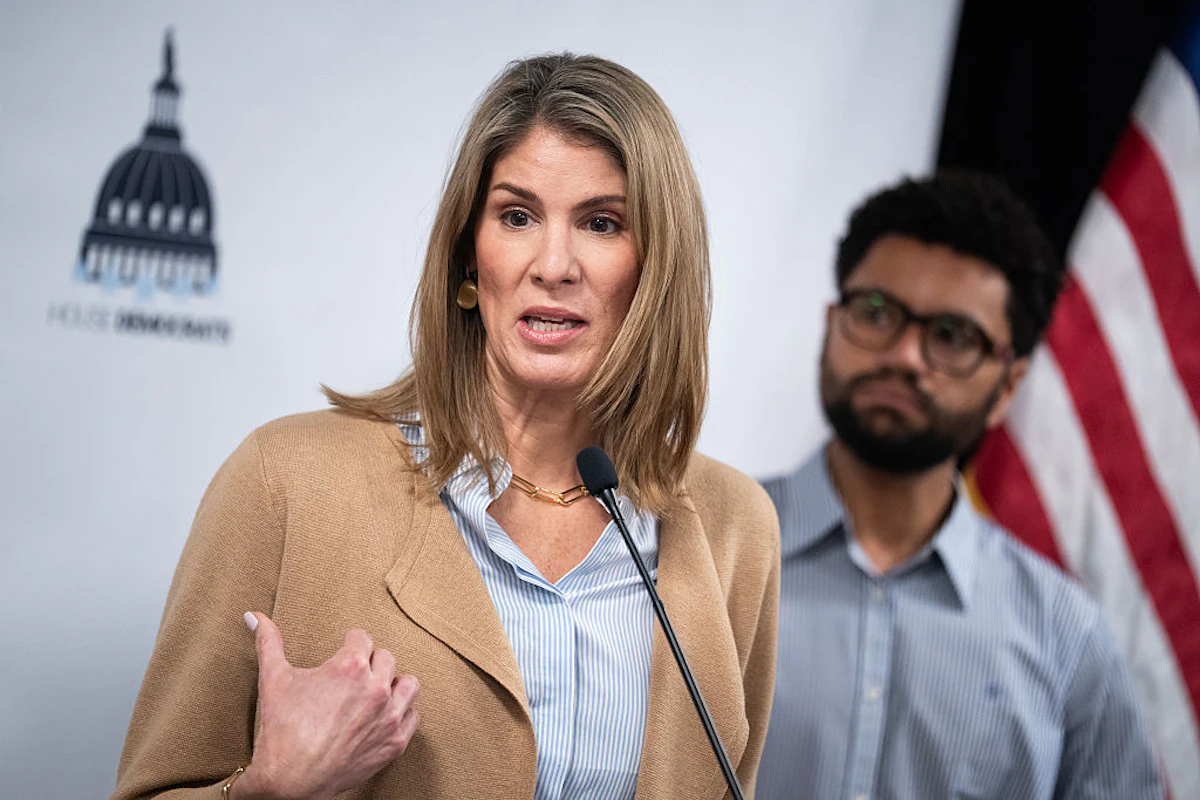
Democratic lawmakers, many of whom were already concerned about AI, say that this week’s incident has lit a fire underneath them. Representative Lori Trahan, who proposed a new bipartisan AI regulation bill on Thursday, said that the news had “accelerated our conversations, pushing lawmakers to shift from “a discussion draft to a piece of legislation.”
Trahan and Republican Representative Jay Obernolte’s bill, the Frontier Risk Oversight, National Transparency, Independent Evaluation, and Reporting, or FRONTIER, Act, would require the biggest AI companies to implement plans to address catastrophic risks, including cybersecurity threats. The bill also calls for third-party auditors to ensure that AI companies follow their own plans. Some state lawmakers—for example New York Assemblymember Alex Bores, who helped draft New York’s 2025 Responsible AI Safety and Education Act—have warned that a broader version of the bill released in June, called the Great American AI Act, could “block” stronger state-level AI regulation.
But Democrats on the Hill reiterated on Thursday that some kind of federal law is needed, and quickly. “The ability to not rely on an administration, executive fiat, or a voluntary model of reporting—we need to make that a mandate, and Congress needs to lead on that,” Trahan said.
“We should not rely upon the good citizenship of these companies,” agreed Senator Brian Schatz of Hawaii.
Deciding what that legislation should look like, though, is easier said than done. The Brennan Center, which maintains a tracker of the AI-related legislation proposed by Congress, lists 112 pieces of legislation that had been introduced as of September 2025 without being passed. That doesn’t count bills introduced in the past year.
Representative Ted Lieu and GOP Representative Nathaniel Moran introduced their own new bill on Thursday. Their AI Kill Switch Act would require companies to report security incidents and create a system to shut down or pause their most powerful AI models.
Representative Suhas Subramanyan, who is a co-sponsor of the FRONTIER Act, said he believes the two pieces of legislation are complementary. He called for Congress to mark up the FRONTIER Act in September and push a vote by the end of the year. “That’s my plan,” he told me. “We need to act in Congress. It needs to be this Congress. We shouldn’t wait until next Congress,” he said. (The new Congress will be sworn in in January 2027.)
Obernolte also sees opportunity for compromise between separate proposals. “I don’t think it’s a competition,” he said. “We welcome all.” He believes his bill has a strong chance, given its “traction in committee” and bipartisan sponsorship.
Not everyone is as optimistic that these proposed bills will actually rein in Big Tech. “That’s a start, but it makes no sense to draft on the fly,” Warren said when I asked what she thought about bills that call for mandatory reporting and independent oversight. “That’s how Congress ends up telling itself it fixed a problem but it didn’t really carefully stitch up the loopholes and solve much of anything.”
—Emma Janssen
Outside Washington
What North Carolina’s fundraising shortfall says about the broader electoral map
Amid the headlines over Rob Sand’s fundraising “haul” in Iowa or James Talarico’s in Texas, one race has been less of a cash battle than anticipated. Western Carolina University professor Christopher Cooper observes in The Assembly this week that North Carolina’s Senate race between Democrat Roy Cooper (no relation) and Republican Michael Whatley is massively underperforming relative to the “billion-dollar” predictions previously made by political insiders. “In the first half of 2026, Whatley raised $5.8 million to Cooper’s $16.1 million,” Cooper writes. “Candidates in the U.S. Senate race in Texas raised 2.7 times as much as Cooper and Whatley’s combined haul during that period. Georgia candidates raised 1.7 times as much, and Ohio candidates 1.4 times.”
Cooper theorizes that the discrepancy between prediction and actual fundraising may reflect how rapidly the electoral map has shifted in the last six months: “In January, North Carolina looked like the most competitive Senate election in the country. States like Texas, Alaska, Ohio, and Iowa weren’t considered in play.” Cooper and Whatley are bringing in less cash, in other words, because Republicans have lost ground in states that were once considered secure—and perhaps because Cooper has led consistently in the polls, although the race seems to have tightened a bit lately.
Elsewhere:
In case you missed it: Former Democratic senator and Governor Ben Nelson of Nebraska penned an op-ed in The Washington Post arguing that a wealth tax would hurt family farms
Policy Matters Ohio tax expert Zach Schiller tells the Ohio Capital Journal that Republican gubernatorial candidate Vivek Ramaswamy’s proposal to “reduce the growing property tax crisis” is “lousy,” while Democrat Amy Acton’s proposal is “sensible” but “nowhere near enough.” Read the full analysis here.
—Heather Souvaine Horn
The Ideas Factory
The Urban Institute hosts an event next Monday at 2 p.m. on “Tackling Housing Supply and Affordability Challenges Through Mixed-Income Housing Finance Innovations.” Speakers include Invest Chattanooga president Matt Bedsole, Colorado Office of Economic Development and International Trade director of innovative funding for housing programs Hilary Cooper, and the Urban Institute’s Laurie Goodman, Daniel Hornung, Chrystal Kornegay,
and Christina Plerhoples Stacy.
The Yale Program on Climate Change Communication releases a new report, “How Local Governments Can Use Communication to Drive Climate Action.” One of the suggestions: “Identify key messengers,” including “doctors and nurses, faith leaders, business leaders, and community-based organizations.”
Public Citizen files a petition with the Food and Drug Administration, saying the agency should “ban direct-to-consumer (DTC) advertising of prescription drugs.” Boy, would that change the experience of watching television …
Earlier this week, the Urban Institute’s William J. Congdon, Elisabeth Jacobs, Amanda Briggs, Ryan Kelsey, Shayne Spaulding, Oluwasekemi Odumosu, and Julia Payne released an article outlining “Policy Priorities for an Inclusive AI Economy.” A few of their proposals: “use AI to match workers with jobs and employers with talent,” “update” labor regulations to address the risks of AI, “incorporate worker voice in AI design and implementation,” “improve policies and programs for displaced workers,” and “ensure gains in productivity and prosperity are widely shared.” So, basically a complete redesign of how the AI transition is currently going.
—Heather Souvaine Horn
In Closing
Good week: Troy Jackson
The Senate candidate in Maine effectively cleared the Democratic field on Sunday, when it was revealed he had the support of a majority of delegates who were elected to attend the party’s convention this Saturday. The other four leading candidates promptly dropped out. Then, on Wednesday, Jackson’s nascent campaign announced that it had already raised $1 million since he entered the race two weeks ago, after Graham Platner’s implosion.
Bad week: Andrew and Tristan Tate
The MAGA-loving, women-hating brothers were arrested in Miami last weekend and are facing extradition to England over charges of rape and sex trafficking. The manosphere influencers are accused of “choking women, sometimes until they passed out, and then raping them”—which comes as no surprise to anyone who read Heidi Blake’s recent, definitive investigation in The New Yorker of their “empire of abuse.” Now their MAGA backers are suddenly ghosting them.
Political Trivia Question of the Day
Whom did Clarence Thomas replace on the Supreme Court, and what was notable about his departure from the court? That is, it had a vast historical impact that few could have guessed at the time. (Sign up for The Blue Book to find the answer in tomorrow’s newsletter.) ...
이 뉴스, 어떠셨어요?
탭 한 번으로 반응 · 로그인 불필요