Under the shadow of melting monoliths
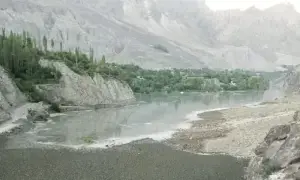
IN THE picturesque valley of Golen, located over 20km northeast of Chitral city, summer once unfolded in all its resplendence. Visitors from across the district would flock to Golen during the warmer months to enjoy its cool mountain air, try their hand at trout fishing, and marvel at its lush green meadows.
Yet, in recent years, that once-bountiful summer has become a source of anxiety for Golen natives.
The cause lies in the glaciers, those primordial agglomerations of ice that had stood sentinel over the valley for centuries, which are now melting at an alarming rate and forming large, unstable lakes in their wake.
On the evening of July 7, 2019, one such glacial lake burst its banks and ravaged the valley, destroying homes and orchards, damaging the headworks of the 108MW Golen Gol hydropower project, plunging the district into darkness for several days. The very next year, Golen experienced another glacial lake outburst flood (Glof).
With over 80 potentially dangerous glacial lakes dotting the region, communities in the Hindu Kush live in fear of advancing, unfrozen glaciers
Last week, as rain fell over the valley, the villagers endured a sleepless night. Safia Bibi, a resident of Golen, told Dawn that terror gripped them when the rain began. “Initially we were terrified,” she recounted, “but later, when the men told us it was too cold and that we should not fear a flood from these clouds, only then did our frayed nerves calm.”
Safia remembers all too well what happened in 2020, when she had to make a dash for safety, clutching her one-year-old daughter in the pouring rain as a Glof carrying huge boulders and debris descended on her village. A portion of her under-construction home was badly damaged, and a few months later, her husband purchased land in a neighbouring village to relocate, due to constant threat of Glofs in their native area.
But Golen is not unique, and other remote valleys across the Hindu Kush are grappling with the same dilemma. Their communities, long ensconced in geographical remoteness, lived in harmony with nature for centuries. Now, extreme weather has thrust them onto the front lines of an unfolding climate catastrophe — one in whose making they have played no role and to which they have contributed nothing.
As climate change wreaks havoc across the globe, unleashing unprecedented consequences on even the planet’s most pristine and remote corners, its impact is especially pronounced in the Hindu Kush, where communities have long lived in close proximity to rugged, unforgiving terrain.
Over 130 ‘potentially dangerous’ lakes
Figures released by the Space and Upper Atmosphere Research Commission (Suparco) on its ‘SpaceforClimate’ portal paint a worrying picture for millions living across the Hindu Kush.
The agency’s June 5 update recorded 24 unfrozen glacial lakes in northern Pakistan, with 15 in Khyber Pakhtunkhwa — 10 of them in Upper and Lower Chitral, three in Swat, and one in Lower Dir.
By July 2, that number had nearly doubled to 40, with Suparco noting that most lakes were concentrated in Chitral, Upper Dir and Swat. The agency said it is regularly monitoring Potentially Dangerous Glacial Lakes (PDGLs) via satellite imagery to support early warning and preparedness for Glof hazards, drawing on a combined list of 131 PDGL locations supplied by the Provincial Disaster Management Authorities (PDMAs) of KP and Gilgit-Baltistan and Wapda’s Glacier Monitoring and Research Centre.
“As expected with rising summer temperatures, the number of unfrozen glacial lakes is increasing… indicating accelerated seasonal melting,” Suparco said, adding that most unfrozen lakes remain within their previously recorded maximum extents.
A lake becomes a greater concern, it noted, when its water extent exceeds historical highs, since this can signal increased storage and higher risk of moraine dam instability. The agency urged authorities to maintain heightened preparedness in downstream valleys given the continuing temperature rise.
Separately, data from KP’s Provincial Disaster Management Authority (PDMA) shows 63 Glof-vulnerable lakes and 21 potentially dangerous ones spread across five districts: nine vulnerable sites in Chitral (Upper and Lower), 18 in Upper Dir, 31 in Swat, and five in Upper Kohistan. All 21 potentially dangerous lakes are confined to Upper and Lower Chitral.
‘Especially vulnerable’
Chitral-based glacier researcher Hamid Ahmed Mir, who has visited many of these sites, told Dawn that the region’s glaciers are unusually vulnerable because of their small size. With the exception of Tirich-Concordia and Chiantar — the latter feeding the Kabul River — nearly all Hindu Kush glaciers are small, making them highly sensitive to temperature spikes.
These ‘water towers’ are likely to assume even greater importance over the coming years as the water war between India and Pakistan intensifies.
He also pointed to steep slope gradients and high seismic activity, noting five to six fault lines run beneath Chitral alone, alongside a high frequency of minor earthquakes.
Much of the region’s development has been unplanned, often ignoring its fragile ecosystem and lacking proper risk assessments or environmental impact studies. For example, he cited the use of explosives to dig the three-kilometre headrace tunnel for the Golen Gol hydropower project, inaugurated in 2018 — two years before a major Glof struck the valley.
Mir also pointed to Chitral’s status as an air-shed valley, where surrounding high mountains trap air, dust and pollutants. His recent research on dust generation from traffic on the largely unpaved, poorly maintained, and decade-long-under-construction Chitral–Mastuj road found that the 110-kilometre stretch could be producing approximately 40,000 tonnes of airborne or fugitive dust every year, including nearly 9,600 tonnes of respirable PM₁₀ particulate matter.
“The Chitral–Mastuj road is a vital transportation corridor that supports communities, trade, and tourism. However, its predominantly unpaved surface also represents a significant source of fugitive dust,” the research paper noted, adding that preliminary engineering estimates suggest around 28,000 tonnes of that dust settles within the surrounding valley annually.
The paper warned the implications extend far beyond roadside nuisance, as dust affects human health, agriculture, alpine ecosystems, water resources, and glacier stability — potentially amplifying the impacts of climate change in one of Pakistan’s most environmentally sensitive mountain regions. It recommended improved road surfacing, dust suppression, vegetation restoration, and systematic environmental monitoring to protect both local air quality and long-term water security in Chitral and further downstream.
Government response
KP PDMA Director General Arifullah Awan told Dawn the provincial government was pursuing both mitigation and adaptation strategies to secure the region against climatic threats.
At least 85 early warning systems, rain gauges and other sensors have been installed across Lower and Upper Chitral, Upper Dir, Swat and Upper Kohistan with support from the United Nations Development Programme (UNDP).
In addition, community-based disaster risk management committees — including union council secretaries and local members — have been formed, with alert times ranging from 20 to 35 minutes. To protect the early warning systems from vandalism, district- and tehsil-level committees have also been set up, with FIRs lodged in the past over damage to the equipment.
The government is also pursuing afforestation, environment-friendly infrastructure, and climate-resilient construction as part of its broader mitigation and adaptation strategy, Awan added.
Published in Dawn, July 27th, 2026 ...
이 뉴스, 어떠셨어요?
탭 한 번으로 반응 · 로그인 불필요