WFI Systems
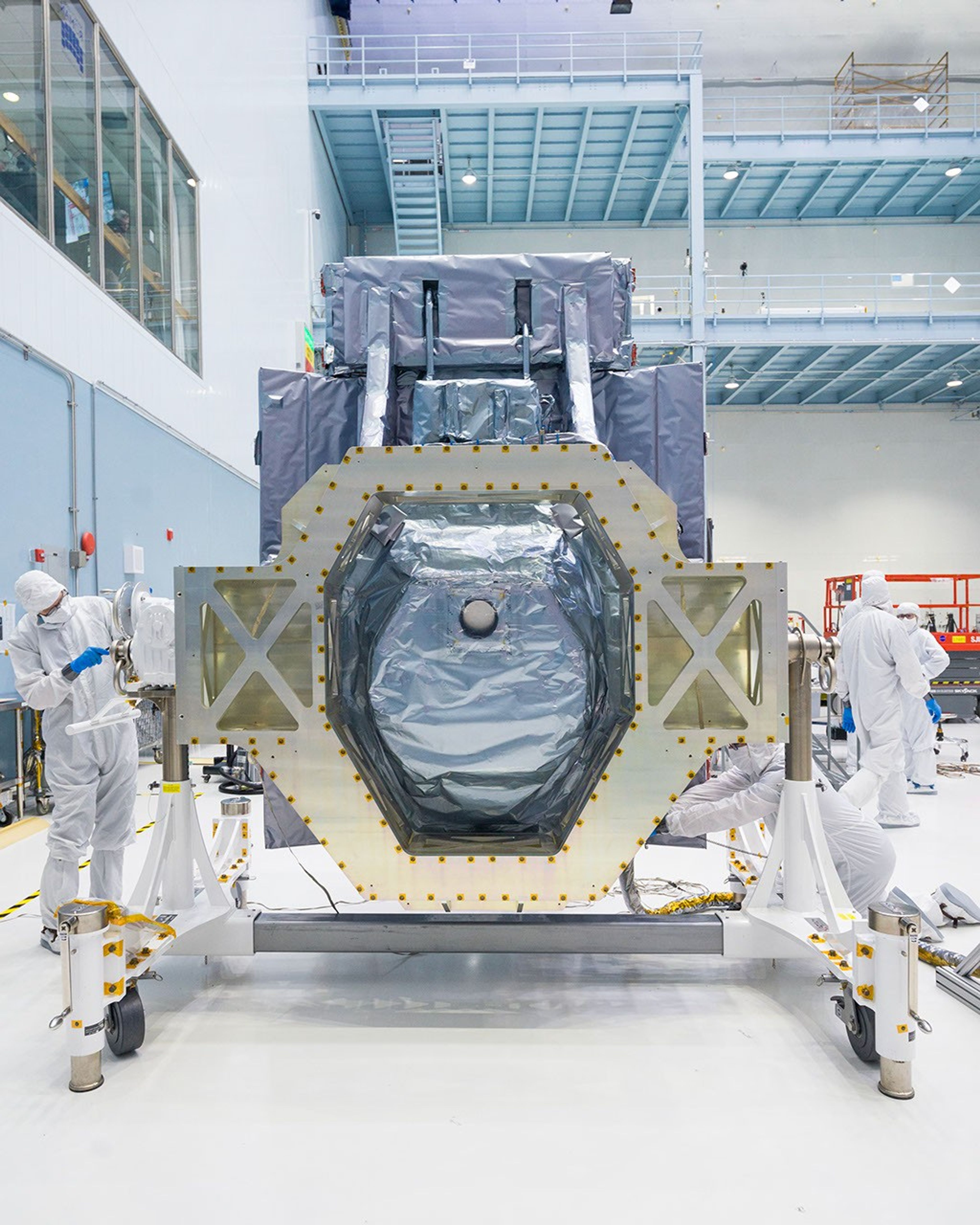
Explore the Wide Field Instrument
These Roman's Wide Field Instrument (WFI) is a 300-megapixel infrared camera that will allow scientists to explore the cosmos all the way from the edge of our solar system to the farthest reaches of space.
Roman’s WFI is fully assembled and undergoing tests to ensure it will withstand the harsh conditions of launch and in space.
Using this instrument, each Roman image will capture a patch of the sky bigger than the apparent size of a full Moon. Hubble’s infrared images, taken with its Wide Field Camera 3, are about 200 times smaller. Even Hubble’s widest exposures, taken with the Advanced Camera for Surveys, are nearly 100 times smaller. Over the first five years of observations, Roman will image over 50 times as much sky as Hubble covered in its first 30 years, surveying the sky up to 1,000 times faster than Hubble can while maintaining similar sensitivity and infrared resolution. Learn more about the Wide-Field Instrument.
Mosaic Plate Assembly (MPA)
The MPA holds the detector array mosaic, the heart of the Wide Field Instrument (WFI). It consists of 18 highly-sensitive large-format detectors arranged into an arch-shaped mosaic. Each detector contains more than 16 million pixels that collect visible and infrared light emitted by astronomical sources. These devices will convert the light they collect into electrical signals, which will then be decoded into enormous images. Combined, the 18 detectors in the array comprise a wide-field imaging camera with more than 300 million pixels. The detectors operate cold, at -288 degrees Fahrenheit (-178 degrees Celsius), to reduce electronic noise and thermal backgrounds. The detector array mosaic will enable the WFI to perform deep surveys of large portions of the sky to study dark energy, exoplanets, and more.
Partner(s)
Focal Plane Electronics (FPE)
The electronics box is the command center of the Wide Field Instrument detectors. It contains electronic components that command each detector in the mosaic, relaying instructions that can be fine-tuned for different science observations. The electronics will also provide power to the detectors and perform onboard data processing and compression.
Partner(s)
Element Wheel Assembly (EWA)
The element wheel is a large disk made of lightweight metal placed in front of the detector array. It has slots around its perimeter that contain calibration hardware, filters for imaging, and the grism and prism for spectroscopy. The element wheel allows the Wide Field Instrument to both tune the wavelengths of light that reach the detectors and spread the light of astronomical objects into spectra. The wheel rotates at its central axis to bring different elements into the light path, changing the instrument's observations. The element wheel is in a housing that contains heaters to hold the wheel and various elements at a constant temperature and limit distortions in the optics.
Partner(s)
Filters, Prism, and Grism
The element wheel contains the filters, grism, and prism. The filters are made of glass with special coatings that only allow light in carefully chosen wavelength bands to reach the detector array. The grism and prism each contain several custom optics designed to spread the light from cosmic objects into spectra over a wide wavelength range. The Wide Field Instrument will combine imaging using the filters and spectroscopy using the grism and prism to study galaxies and supernovae to help us understand dark energy. Observing stars using the filters will reveal exoplanets via a technique called gravitational microlensing. This observational effect occurs because the presence of mass warps the fabric of space-time. When two stars closely align from our vantage point, the nearer star – and any orbiting planets – can lens light from the farther star, making it briefly brighten.
Locations
Radiators and Thermal System
The Wide Field Instrument thermal system keeps the instrument subsystems at their ideal operating temperatures. A system of metal straps and heat-conducting pipes will carry heat produced by the detectors and electronics to radiator panels that face cold space on the outside of the instrument. The excess heat will be radiated away, cooling the instrument components. Thermostats and heaters will precisely monitor and control the subsystem temperatures, holding them in a narrow and stable range so that observations won’t be impacted by swings in temperature that introduce uncertainty in the precision scientific measurements.
Locations
Wide Field Instrument
Roman’s WFI has been integrated onto the instrument carrier along with the Coronagraph Instrument. Using this instrument, each Roman image will capture a patch of the sky bigger than the…
Learn More About Wide Field InstrumentTake a Closer Look
Take a tour around the Roman spacecraft and learn more about each of the systems that make up the telescope.
Explore Roman
이 뉴스, 어떠셨어요?
탭 한 번으로 반응 · 로그인 불필요