Fox News
보수 성향
정치
Trump keeps forecasting an Iran deal — why the White House still thinks it can happen
Trump projects confidence in Iran nuclear deal despite unresolved uranium enrichment disputes and a fragile ceasefire that nearly unraveled.

"FORECASTING" · 총 34건
필터 보기현재 지수
49.5
0 = 부정 우세
50 = 중립
100 = 긍정 우세
최근 7일 기준 88,557건을 분석한 결과, 뉴스 심리지수는 49.5(균형)입니다. 긍정 10,761건(12.2%)·중립 64,154건(72.4%)·부정 13,642건(15.4%)이며, 중립 비중이 뚜렷하게 높습니다. 성향 지수는 종합 19.6(중도 균형)입니다.
Trump projects confidence in Iran nuclear deal despite unresolved uranium enrichment disputes and a fragile ceasefire that nearly unraveled.
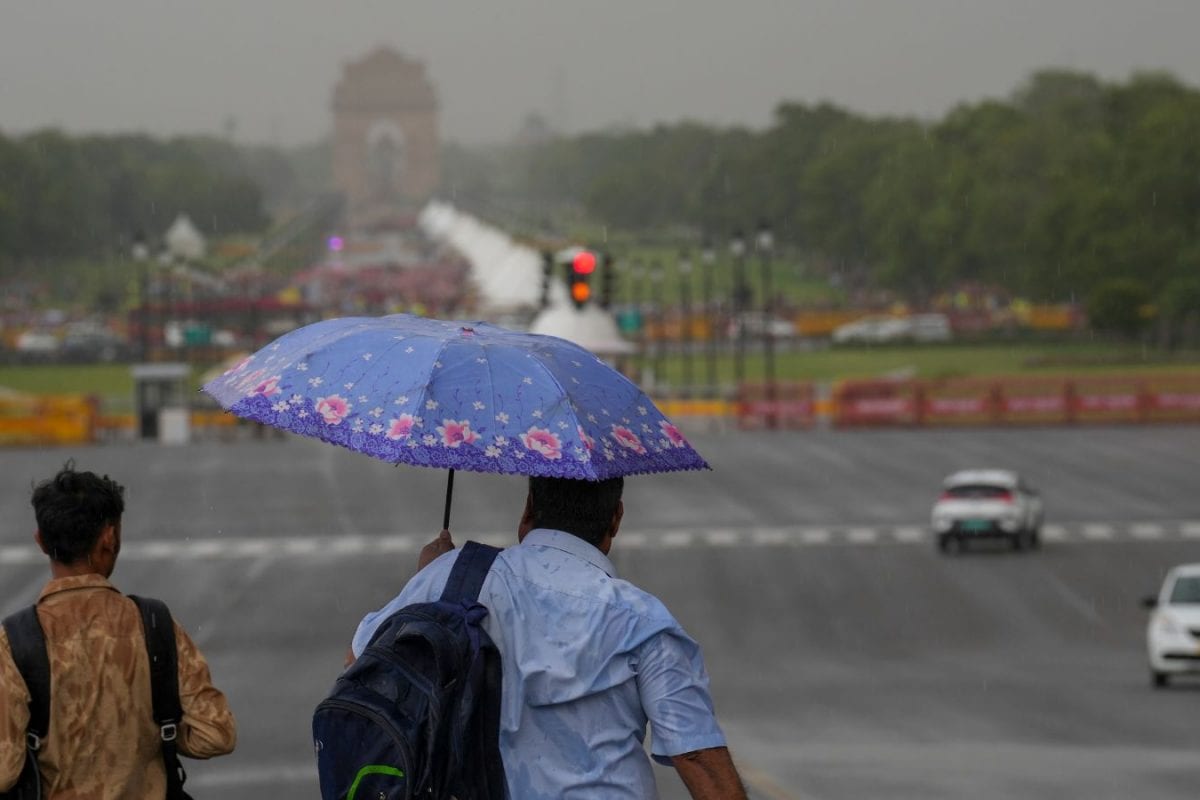
The Regional Weather Forecasting Centre (RWFC) had issued a 'red alert' for Delhi, warning of thunderstorms, lightning, hail and moderate rainfall
World weather forecasting has been "completely upended" by artificial intelligence over the past three to four years, an Oireachtas committee has heard.
The Folgers and Dunkin' coffee maker posted adjusted earnings of $2.77 a share in its fiscal fourth quarter, topping Wall Street estimates

MANILA, Philippines — State seismologists lifted the tsunami warning on Monday following a magnitude 7.8 earthquake in Mindanao. Earlier, Phivolcs issued a tsunami warning, forecasting waves of more than a meter above the normal tides to occur between 7:37 a.m. and 9:37 a.m. “After the extended two-hour observation period, minor sea level disturbances continued to
Fruit sellers at roadsides and bazaars are bracing for Pakistan’s yearly mango madness. Their baskets are filled with the early Sindhri crop for now as they wait for the Punjab Langra and Dusehri, soon to be followed by the Chaunsa and Anwar Ratol. This year’s season arrives with as much anxiety as anticipation. Fluctuating temperatures, erratic rain and hailstorms early in the year, the period critical for flowering, fruit set and ripening, have damaged orchards across Punjab’s mango belt, covering Multan, Dera Ghazi Khan and Bahawalpur divisions in the south and Sahiwal, Faisalabad, Sargodha and Lahore in the central and northern parts of the province. The prolonged stagnation after last year’s floods weakened root systems and stressed trees already battered by climatic shocks. These setbacks, coupled with uncertainty in export markets amid tensions surrounding the US-Iran-Israel conflict, have kept growers, contractors and traders on the edge over the season’s fragility. “I can safely say that around 40 per cent of the crop in my area has been damaged,” said Rabia Sultan, a grower who cultivates several varieties, including Summer Bahisht, White Chaunsa, Anwar Ratol and Sindhri, across nearly 100 acres of fertile land in Kot Addu, South Punjab. Major Tariq Khan, director Lutfabad Farms and director operations Progressive Mango Growers Group, said the yield has been dropping over the last few years, but this year has been particularly “troublesome”. “If you drive through the mango-growing belt of South Punjab for instance, you’ll witness the extent of damage,” he said. Although the Dusehri and Langra have been spared somewhat as they develop earlier in the season. “They had matured before the early-season stress set in. Chaunsa and Ratol that ripen later in the season have been most affected.” Bad weather Usually, from the cool days of February to the scorching months of May and June, each stage of the mango cycle is delicately timed. The trees emerge from dormancy, begin flowering, pollinate, and eventually bear and ripen fruit in smooth succession. This year, however, abrupt temperature swings tore through this cycle. News reports, AccuWeather forecasts, and Pakistan Meteorological Department (PMD) outlooks say that February clearly departed from normal winter conditions across Punjab. It turned unusually warm, with day-time temperatures rising to 24°-28° Celsius and night-time lows ranging between 11°-14°. The PMD said the monthly mean was 17.1°, which is about 2.5° above average. If it was warmer, it was also parched. It rained 88.8pc less across Punjab in February, leaving orchards thirsty at a critical stage of crop development. Perhaps the only upside to this pattern was that it sped up flowering earlier than usual. “We surveyed the orchards in February and saw trees profusely laden with boor (flowering),” said Hafiz Asif Ur Rehman, Principal Scientist, Mango Research Institute in Multan. This development initially gave them the impression that 2026 would yield a bumper crop. Unexpectedly, the mercury stayed up as March rolled around, with day-time highs inching to between 32° and 37° — roughly 2° to 6° higher than normal. The night-time temperatures stayed at between 14° and 18° which was around 1° to 3° above normal for this time of the year. “The high temperatures during this flowering period suddenly reduced pollen viability,” said Riaz Hussain, a scientific officer at the Mango Research Institute. “[This] disturbed pollinator activity, and conducive flowering. It also caused some premature fruit to drop.” Worse, by mid-March, the pattern shifted again. Instead of temperatures transitioning into warmer degrees, they sank from the 30s to the 20s during the day. The night-time temperature remained more or less consistent. This contrast between an unusually hot start and a cooler, unstable end of the month, complicated the crop cycle. Many orchards showed uneven flowering, multiple fruit-setting waves, delayed fruit maturity, and “increased bator or malformed clusters that favour pest infestation, particularly mango hoppers and fungal problems,” said Hussain. April and May settled back into seasonal norms but sporadic hail, rain, and windstorms continued to disrupt the pattern. Temperatures would fall several degrees below average in affected areas. “Such bursts of temperature may scar the mango skin and make it less suitable for export and reduce its market value,” said Waqas Bucha, who manages 30 acres of orchards along Bosan Road in Multan. Drowning Even before the temperatures played up, prolonged waterlogging after the 2025 floods had damaged feeder roots, reduced soil aeration, and weakened overall tree physiology, particularly in low-lying orchards near riverine areas of Chenab. According to the Pakistan Society for Horticultural Science, last year more than 41,000 acres or over half of the total orchards in Multan, Shujabad, and Jalalpur were left under water. “The brunt fell on small and medium-aged orchards, where trees, still in their most productive years, were uprooted or severely stressed,” it said. In several areas, late vegetative growth remained tender for longer periods, making them more vulnerable to insect attacks and nutrient imbalance because saturated soils don’t absorb fertiliser the same way. These conditions created an environment for the hopper and other stubbornly resistant pests. Waqas Bucha has already sprayed pesticides twice, but the disease refuses to go away. Major Tariq Khan has done it thrice, yet the infestation persists. “In some areas,” he added, “farmers have gone up to eight sprays, but still cannot bring pests under control.” Dawn reported on May 13 that the Ministry of Commerce has extended the start of export season to June 1, 2026, saying it was doing so because of stakeholder requests and climatic shifts that have delayed fruit maturity, particularly for the Sindhri. Long-range shifts In the last five years Punjab has had a clear officially documented shift from seasonal stability to exceptional high heat and rainfall. It has prolonged summers, hitting up to 40°-45° Celsius, and shorter and milder winters, with day temperatures ranging between 18°-24° and night-time lows of 5°-10°, both reflecting an estimated 3° rise in mean temperature. Rainfall has become far more unstable. The 2022 monsoon delivered about 77 per cent above-normal rainfall while 2024 again recorded above-normal monsoon activity. Shrinking acreage Across the five-year trajectory, according to the Final Kharif Estimates by the Punjab Agriculture Department, the mango economy shows a clear move from a stable, productivity-led system to an expansion-driven model in which land increase is beginning to compensate for weakening efficiency per acre. In the early phase (2019-20 to 2020-21) the cultivated area was relatively stable, hovering around 240,000-244,000 acres. But yield fell 6pc from 143.79 to 135.02 maunds per acre. In the next phase (2021–22 to 2022-23) the area stayed at 244,500 acres, but yield dropped 4 per cent from 148 to 142 maunds. In 2023–24, the yield increased sharply to 173.5 maunds per acre despite unchanged acreage, possibly due to better weather. Last year, 2024–25, cultivated area jumped 55 per cent to 378,975 acres. But yield dropped to 148.4 maunds per acre, 14.5 percent lower. Dr Azeem Sardar, an Agricultural Development specialist with The Urban Unit, is clear that the changing weather is “one of the major reasons behind the lower mango yield.” Warning signs Tariq Khan’s area was once known for its thriving cotton fields, which were slowly abandoned by farmers who could not keep fighting climate change, pests and sinking yields. He fears mangoes could meet the same fate unless growers adapt. Hafiz Asif Ur Rehman said they advise farmers to adopt careful irrigation, like avoiding watering already wet soil, maintaining a green grass cover outside the canopy to reduce heat stress, spraying water on the sun-facing side of fruit-bearing trees during extreme temperatures above 45°C, and applying mulch under the canopy to regulate soil temperature. Farmers who combine good agricultural practices, such as timely pruning, nitrogen application during dormancy, and scheduled pesticide sprays, have been better able to protect their crops. Weather forecasting and early warning systems help, but Dr Azeem Sardar added that “climate-smart orchard management remains an evolving field in the country.” Experts say transitioning from traditional mango cultivation practices to climate-resilient approaches remains gradual and faces several challenges. “Many small and medium-scale farmers continue to rely on conventional farming practices due to financial limitations, lack of technical knowledge, and restricted access to efficient irrigation systems and quality inputs,” said James Robert Okoth, Officer in Charge, FAO Pakistan. Farmers are slow to pivot but so is government. “We have approached the climate change ministry, Muhammad Nawaz Sharif University of Agriculture, and other bodies, but it is always the same response, ‘yes, yes, let’s do something,’ and then nothing materialises,” he said. Around 92 per cent of mango growers in South Punjab are small landholders who don’t have the capacity to innovate or independently adapt to climate pressures. And each damaged crop and shrinking yield is spreading the fear that the king of fruit, the Pakistani mango may become another casualty of the global climate crisis.
Twice-daily launches from IMD’s Thiruvananthapuram centre continue to provide vital atmospheric data for forecasting
"That scale is possible," said Jason Asher, director of CDC's Center for Forecasting and Outbreak Analytics, during a press briefing. The post US warns Ebola outbreak on scale of largest ‘is possible’ appeared first on Vanguard News.
TORONTO — Toronto and Vancouver cannabis shops and suppliers are expecting a high when the World Cup gets underway next week. B.C.’s pot distributor is forecasting a moderate increase in cannabis demand and sales on match days in Vancouver’s downtown core. Its Ontario counterpart pegged the potential sales boost at 10 per cent for some […]
MetService is forecasting 100km/h gusts and possible tornadoes across the north today.
Severe weather conditions, including rainfall and thunderstorms, disrupted flight operations at Delhi airport on Thursday. Thirteen incoming flights were forced to go around, with 11 diverted to other airports. A yellow alert remains in effect for Friday, forecasting continued light rain, thunderstorms, and strong winds.
Delhi-NCR experienced relief from warm and humid weather as light rain arrived, accompanied by a red alert from the IMD forecasting thunderstorms and gusty winds up to 70 kmph. Residents were advised to follow disaster management guidelines due to the possibility of hail at isolated spots.
By 2030 Honeywell is targeting annual earnings of at least $6.5 billion and full-year free cash flow of at least $4 billion.
Chancellor Rachel Reeves has been warned that government borrowing is set to spike as a result of the Iran war, as the Office for Budget Responsibility admitted it had underestimated the effects of the last energy price shock. In a review of its forecasting models, the OBR suggested it had learned lessons from Russia’s full-scale invasion of Ukraine, which led to gas prices rising by around five times. It said the overall impact on public finances “was to significantly increase government borrowing and debt” despite…
This sponsored article is brought to you by Black & Veatch. The biggest challenge facing utilities today isn’t what it seems. It’s not demand, even as load growth accelerates. It’s not extreme weather, even as “major events” become routine. It’s not cybersecurity, even as connections expand across the grid. The real challenge is this: Distribution systems were designed for a different reality. Long gone are the days of predictable demand, one-way power flow and isolated disruptions. At Black & Veatch, we see that leading utilities are no longer debating whether to modernize. They’re deciding how quickly they can do it, and how to do it at scale. Across grid modernization programs globally, three truths consistently emerge. They define what it takes to prepare the distribution system for what’s next: 1. Outage response is not a resilience strategy Resilience is being redefined in real time. A strategy centered on mobilizing crews and restoring service as quickly as possible is reactive, and increasingly insufficient. Resilience has to shift upstream into integrated system design. That starts with hardening. Stronger poles, undergrounding and structural upgrades all have a role, particularly in high-risk corridors. We’re also seeing meaningful gains from how the network is configured and how quickly it can respond without waiting on manual intervention. This is where distribution automation programs can change outcomes. Strategically placed reclosers, automated switches and fault indicators help contain disruptions before they spread. When combined with feeder reconfiguration and updated protection strategies, distribution automation investments allow utilities to set more aggressive recovery targets and achieve measurable reductions in outage duration and customer impact. 2. Future-readiness depends on DERs at scale Forecasting is less and less reliable. Only 19 percent of utilities report strong confidence in their ability to predict future load growth, according to the Black & Veatch 2025 Electric Report. Distributed Energy Resources (DERs) like solar, storage, EVs and behind-the-meter generation are exciting solutions; but they fundamentally change how the system operates. Power is no longer just delivered. It’s injected, stored and redirected in ways the system was never designed to manage. At scale, these challenges show up quickly — particularly on feeders where distributed generation is approaching or exceeding hosting capacity. Protection coordination becomes more difficult when fault current comes from multiple directions. Voltage becomes less predictable as generation fluctuates throughout the day. And planning models must now account for highly variable, location-specific behavior. Distribution modernization is fundamentally changing how the system is designed and operated so it can absorb disruption, manage bi-directional flows and respond in real time. Adapting to bi-directional power flow requires more than incremental updates. Leading utilities are responding by building flexibility into the system, moving beyond static assumptions toward dynamic hosting capacity and interconnection studies, planning that incorporates DER, EV adoption and localized load growth, and infrastructure aligned with the communications and control needed to manage it. 3. The edge must be intelligent, visible and secure As system stress and complexity increase, utilities need far greater visibility and control over the network. Historically, utilities relied on customer calls, Supervisory Control and Data Acquisition (SCADA) at the substation level and field crews to understand what was happening on the system. That model doesn’t hold up. You can’t effectively manage a system you can’t see. Plus, the most critical events are increasingly happening beyond the substation — on feeders, laterals, and at the edge where DER and customer behavior are interacting with the grid. Grid-edge technologies have become essential. Sensors, Advanced Metering Infrastructure (AMI) and automated switching provide the raw data and control needed to move from reactive to proactive operations. In more advanced deployments, utilities are creating centralized control environments that allow operators to see and manage the distribution system in near real time. That capability is enabled by: Advanced communications networks to form the backbone of real-time grid visibility Distribution Management System (DMS) and Outage Management System (OMS) to enable faster, more coordinated system response Analytics, AI and machine learning to improve situational awareness, anticipate system conditions, and support operational decision-making The same connectivity enabling this real-time visibility and control also introduces new vulnerabilities, blurring the line between physical and cyber risk, yet many utilities manage them separately. Only 22 percent have unified teams in place, even as threats continue to rise, including a 50 percent increase in substation attacks and growing exposure to malware and ransomware, according to the Black & Veatch 2025 Electric Report. Cybersecurity and resilient network design must be embedded into the architecture from the outset—not layered on after the fact. See what bolder vision looks like Distribution modernization is fundamentally changing how the system is designed and operated so it can absorb disruption, manage bi-directional flows and respond in real time. To learn about a successful program, check out Georgia Power’s recent grid modernization program. Black & Veatch partnered with the utility on large-scale infrastructure upgrades. The results? Outages are down 76 percent, restoration times have improved by more than 80 percent and communities across Georgia are powered by a grid built to meet the future head-on. When the state faced the most destructive storm in the company’s history, Hurricane Helene, Georgia Power deployed a rapid response team that utilized its “smart grid” and restored power to more than 1 million customers within days. A grid built to meet the future head-on—that’s the result of bolder vision.
[Politics] : KBS and other major broadcasters will release the results of their joint exit poll for the local elections at 6 p.m. Wednesday. The poll is conducted by the Korea Election Pool, a joint election forecasting committee formed by the country’s three major broadcasters — KBS, MBC and SBS — along with ... [more...]
BoM and other agencies expect transition to the first El Niño since spring 2023 sometime during winter Follow our Australia news live blog for latest updates Sign up for climate and environment editor Adam Morton’s free Clear Air newsletter here Australia should prepare for an imminent El Niño, with the Bureau of Meteorology and other agencies forecasting that the weather phenomenon is likely to develop in the coming months. “The models are really aligning now,” Felicity Gamble, a senior BoM climatologist, said. “We are expecting a transition to El Niño sometime during winter.” Continue reading...
China officially entered its annual flood season on June 1, with authorities warning of heightened flood risks across southern regions and forecasting possible flooding above warning levels in several major river systems this month, according to media reports.
The Ministry of Water Resources has pledged to fully leverage the digital twin system it has developed to enhance flood forecasting, as parts of the country move into a critical flood period.
[Politics] : South Korea’s three major terrestrial broadcasters — KBS, MBC and SBS — will conduct a joint exit poll to forecast the outcome of Wednesday’s nationwide local elections. The survey will be carried out by the Korea Election Pool(KEP), a joint election forecasting committee formed by the three ... [more...]