The Independent (World)
진보 성향
정치
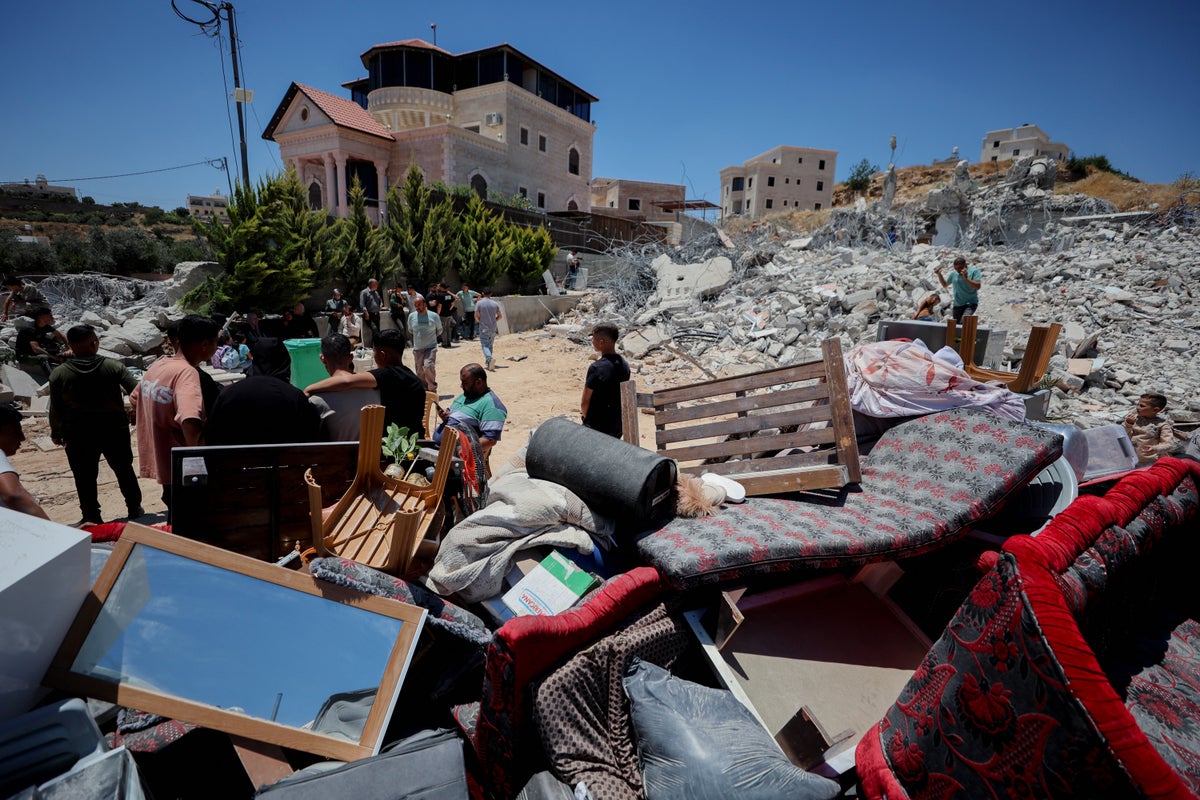
부정적UN report accuses Israel of being complicit in deadly settler attacks on Palestinians
Israel rejects charges that its troops shield settlers during attacks on Palestinians in the West Bank,
"COMPLICIT" · 총 27건
필터 보기현재 지수
49.5
0 = 부정 우세
50 = 중립
100 = 긍정 우세
최근 7일 기준 88,756건을 분석한 결과, 뉴스 심리지수는 49.5(균형)입니다. 긍정 10,786건(12.2%)·중립 64,295건(72.4%)·부정 13,675건(15.4%)이며, 중립 비중이 뚜렷하게 높습니다. 성향 지수는 종합 19.6(중도 균형)입니다.
Israel rejects charges that its troops shield settlers during attacks on Palestinians in the West Bank,
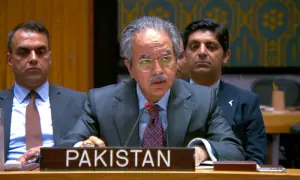
WASHINGTON: Pakistan’s envoy to the United Nations said on Monday that India’s key objectives in Afghanistan were “solely driven by the singular goal of destabilising Pakistan”. He made these remarks during a UN Security Council meeting on Afghanistan while responding to remarks by Afghanistan’s Permanent Representative to UN Nasir Ahmad Faiq. Earlier in the session, Pakistan’s Permanent Representative to UN Ambassador Asim Iftikhar Ahmad detailed the use of Afghan soil by terrorists and its impact on Pakistan, calling for the Afghan Taliban to take action against militants. He also spoke about Pakistan’s counter-terrorism measures. Faiq also commented on Pakistan’s counter-terrorism operations, in response to which Ambassador Ahmad said: “Pakistan’s actions, including those conducted in March, were directed solely against the terrorist and military support infrastructure that is operating from Afghanistan. And it is in no way directed against the brotherly people of Afghanistan.” ‘Verifiable, non-reversible action’ Ambassador Ahmad earlier told the UNSC that Islamabad’s demand from the Afghan Taliban was simple and clear: “verifiable and non-reversible action“ against terrorist groups operating from Afghan territory. “Regrettably, this demand remains unmet,” he said. And while the window for course correction was narrowing, it remained open, he added. “We hope the Taliban realise this in earnest and cooperate with the international community for the long-term peace and development of Afghanistan and, above all, in the best interest of all Afghans,” he said. There has been a resurgence in terrorism in Pakistan since the Afghan Taliban returned to power in Kabul in 2021. For its part, Islamabad has repeatedly urged the Taliban administration to dismantle terrorist sanctuaries on Afghan soil, particularly those linked to the banned Tehreek-i-Taliban Pakistan (TTP). But, officials say those appeals have gone unheedeed, while the Afghan Taliban reject these allegations. During the UNSC meeting, Ambassador Asim noted that it had been nearly half a decade since the Taliban takeover of Afghanistan in 2021. “It was hoped that this would end the bloodshed and Afghanistan would be at peace with itself and its neighbours,” he said. The envoy added that with the end of the civil war, it was “anticipated that the Taliban would take positive steps to transform into a responsible governing authority by adhering to their international obligations and commitments, and that they would lead Afghanistan into an era of stability and progress, provide the long-awaited relief to all Afghans and live in harmony with immediate neighbours”. “For decades, terrorism has been a major problem in Afghanistan, with implications not just for Afghanistan, but the immediate neighbourhood and beyond. Afghanistan has a history of being a safe haven for terrorist groups, including those used as proxies by our adversaries to target Pakistan and other countries,” he highlighted. It was “our expectation that the Taliban would take concrete and verifiable actions against terrorist groups such as the TTP, Balochistan Liberation Army (BLA) and its Majeed Brigade, Islamic State-Khorasan, East Turkestan Islamic Movement and their affiliates that are operating with impunity on Afghan soil”. “Regrettably, they have failed to undertake action, showing complete disregard for the legitimate security concerns of Pakistan and other countries,” the ambassador said. He added that, besides “independent analysis and reports of the Analytical Support and Sanctions Monitoring Team, which clearly outline the terrorism situation in Afghanistan and the ground realities, along with the recent exponential rise in terrorist attacks in Pakistan, these developments serve as glaring reminders of the precarious situation and the continuing threats posed to international peace and security”. “As a direct result of the freedom with which these terrorist groups operate in Afghanistan, Pakistan has borne the brunt of their attacks, as well as the Taliban’s growing nexus with these terrorist groups. “And once again, a significant number of Afghans are found to be involved in terrorism inside Pakistan,” he added. He said these terrorist groups had access to advanced weapons and sophisticated equipment, including drones. “Much of this can be traced back to the multi-billion dollar worth of arms and ammunition left behind by foreign forces — which was meant for use by the previous Afghan national government,” he said. Moreover, during counter-terrorism operations by Pakistan, there have been more than 290 cases of seizures of such weapons, which are used for terrorism and suicide bombings in the western parts of Pakistan, and which have exacted a heavy toll of human life and material losses, he told the UNSC. In 2025 alone, Pakistan reported more than 5,300 terrorist incidents and lost more than 1,200 lives to terrorism emanating from Afghanistan, he said. In this connection, he recalled that a vehicle-borne IED attack by the TTP on a police post in Khyber Pakhtunkhwa on May 9 resulted in the martyrdom of 15 police officers. “Our investigations revealed that the attack was planned by terrorists in Afghanistan.” Ambassador Ahmad said: “It is deplorable that the Taliban have reverted back to their old tactics of providing safe havens to terrorist groups and chosen the perilous path of complicity, backed by an outside actor, the historic spoiler and instigator of chaos — that has moved fast as an opportunist to wage a proxy war against Pakistan. “Let me make it clear: Pakistan will defend itself against whosoever attempts to harm our sovereignty, territorial integrity and national security.” He continued that Pakistan had always expressed openness for dialogue. “Numerous diplomatic efforts were made to counsel the Taliban. We thank friendly countries for their genuine mediation efforts, particularly Qatar, Turkiye, Saudi Arabia and most recently, China, to find amicable solutions. Yet the Taliban’s continued intransigence and even refusal to publicly denounce and condemn terrorist groups such as the TTP and BLA is deeply disturbing — it is evidence enough of their complicity and active support for these groups. Pakistan will not sit idle while suffering from terrorist acts. We will respond in self-defence, as and when needed and always in conformity with international law and International Humanitarian Law,” he said. Referring to a recent report by the UN secretary general, he said it “seems to largely externalise the responsibility for Afghanistan’s multifaceted challenges”. “The fatalities of terrorists and their supporters as a result of counter-terrorism operations are mentioned within the ambit of ‘civilian casualties’, posing serious questions on the credibility of UNAMA’s reporting from Afghanistan and the nature of their engagement with the Taliban. UNAMA is swift in reporting incidents of cross-border actions and casualties but fails to provide the overall context — which is the grave terrorist threat emanating from Afghanistan and its cross-border impact directed at Pakistan that is harming Pakistan and killing innocent Pakistanis,” he elaborated. He further said that the report also did not provide information on the destabilising accumulation of small arms and light weapons inside Afghanistan. “Nor does it adequately shed light on Afghanistan’s illicit economy, with its complex web of money laundering and terror financing networks, including hundi and hawala networks. Instead, the report resorts to shifting the blame on external dynamics, with little regard for the Taliban’s own policies that have brought Afghanistan to the brink of disaster,” he said. The envoy stressed that “we must not lose sight of the fact that it is the Taliban’s reckless style of governance and flawed ideologies of extremism, suppression and radicalisation that have brought upon Afghanistan the calamities it faces today”. “The Humanitarian Needs and Response Plan for 2026, we are told, is underfunded at 14 per cent — again a direct result of Taliban’s unwillingness to prioritise the welfare of Afghans over their own interest and authoritarian control,” he pointed out. Noting that several references had been made to the Pak-Aghan border closure in the report, he said: “Let me clarify that the closure of border between Pakistan and Afghanistan does not, from Pakistan’s perspective, affect the movement of humanitarian supplies. “Pakistan has been processing and facilitating the passage of humanitarian goods and material. However, the Afghan Taliban regime refuses to let them pass and keeps the border closed on its side, even to receive such life-saving cargoes, which obviously is to the detriment of the Afghan people.” He went on to say that the worsening human rights situation in Afghanistan “aligned with Taliban’s failings and deceitful narrative to meet the demands of the international community”. “Women and girls are denied their fundamental human rights and dignity, with discriminatory and abusive practices — a clear violation of their international obligations as well as of Islamic laws, traditions and tenets of the Muslim faith. The Afghan people are being held hostage to these inhumane restrictions, oppression and selfish behaviour,” he said. He said that Pakistan took numerous steps to support Afghanistan, including humanitarian relief efforts, political engagement, providing incentives to boost bilateral trade, offering transit concessions, issuing student and medical visas, conducting high-level visits to Kabul and participating in various regional cooperation initiatives to help Afghanistan succeed in its quest to find its rightful place in the international community. For over four decades, he continued, Pakistan welcomed millions of Afghan refugees “despite limitations and insufficient international support, dealing with huge caseloads of illegal Afghans, including those without documentation, posing a serious threat to our security”. But these were never meant to stay indefinitely, he added. The ambassador called on the UN secretary general to “clearly outline the status of third country resettlement cases of Afghans in a transparent manner — cases that are pending for years, despite being a tiny fraction of what Pakistan had to deal with, in the face of national security threats that no country would tolerate”. “While we provide all possible facilitation, the international community must step up and shoulder its responsibility. Shifting the blame of Afghanistan’s woes to the inflow of Afghan returnees will not solve the problem,” he said. Ambassador Ahmad further said, “We look forward to the next steps of the UN-led Doha Process and action plan for its Mosaic approach, to address Afghanistan’s multifaceted challenges comprehensively, with well-defined objectives and a realistic roadmap as the only viable pathway for normalisation”. Pakistan and Afghanistan, he said, were bound by geography, deep-rooted ties, civilisational links dating back centuries, and fraternal bonds of faith, culture and ethnicity. “No country has suffered more from the consequences of conflict and instability in Afghanistan than Pakistan. So we understand, and we also know, that no country stands to benefit more from peace, prosperity and stability in Afghanistan than Pakistan. “Pakistan’s demand from the Taliban is simple and clear: verifiable and non-reversible action against terrorists. Regrettably, this demand remains unmet. The window for course correction is narrowing but is still open. We hope the Taliban realise this in earnest and cooperate with the international community for the long-term peace and development of Afghanistan and, above all, in the best interest of all Afghans,” he said, concluding his address.
Facing a possible life sentence, the former physician, now 67, has completely changed his defense strategy. Rwamucyo's appeal trial is set to begin on June 9.
Activists claim sanctions fail to reflect either the depth of violence or state complicity in settler attacks.
Colombian President Gustavo Petro argues the U.S. has chosen to align against his government and back forces he identifies as complicit in the drug trade.
Democracies can either defend rights in the digital age, or drift into complicity as the architects of a new, global authoritarianism enabled by AI.
François Picard is pleased to welcome Juliette Bour, historian and author of a forthcoming book in French entitled "Like Men: Women Politicians Complicit in the Rwandan Genocide". More than three decades after the 1994 genocide against the Tutsi in Rwanda, France continues to confront difficult questions about its political, military and diplomatic role during one of the most horrific atrocities of the 20th century. The inauguration of a memorial and monument in Paris, attended by President Emmanuel Macron, marks another step in a long and contentious process of historical reckoning.
TEHRAN (Sputnik) - Tehran condemns the US strikes on Qeshm Island and the attack on an Iranian tanker, reiterating Iran's right to defend itself, and blames Kuwait and Bahrain for complicity, the Iranian Foreign Ministry said on Wednesday.
Rwanda's President Paul Kagame is in Paris with President Emmanuel Macron for the inauguration of a new memorial site dedicated to the victims of the 1994 Genocide against the Tutsis. More than one million Tutsis were killed over a period of just over 100 days. France at the time, was accused of complicity in the genocide because of its ties with the then Rwandan government. FRANCE 24's James André reports from Paris.
Contrairement à ce qu’avaient annoncé ses avocats à l’issue du jugement, le commissaire a finalement renoncé à faire appel, scellant ainsi sa culpabilité dans un des principaux scandales de la lutte antidrogue en France.
Mamata Banerjee challenged the BJP to arrest her, accusing them of attempting to dismantle the Trinamool Congress through intimidation and bribery. She vowed to protest on June 2, even without official permission, and threatened to move the demonstration to Delhi. Banerjee also alleged widespread election rigging and police complicity in suppressing dissent in Bengal.
L’entreprise tricolore a été condamnée pour «complicité de violation des conditions générales d’utilisation» et doit désormais verser 785.000 euros de provisions à Netflix, Apple et Disney.
The identities of four police officers accused of complicity in the alleged extrajudicial killing of 28-year-old Oghenemine Ogidi, popularly known as OG Millions, were made public on Monday as a High Court sitting in Asaba remanded five suspects in custody. The post Oghenemine killing: Court remands five police officers, identities of alleged accomplices revealed appeared first on Vanguard News.
Mayoral candidate Spencer Pratt tore into Gov. Newsom and Mayor Bass over their handling of the wildfires and homelessness.
L’équipe de France a bouclé le premier entraînement de sa préparation au Mondial, vendredi à Clairefontaine. Une reprise sous le signe de la bonne humeur.
Mr. Gandhi asks whether any background check was conducted into the controversial company that won the contract for the CBSE OSM process, accuses Mr. Pradhan of being “complicit”
D’après «le Parisien», le présentateur de France 2 a déposé des plaintes contre le premier pour «complicité de harcèlement moral aggravé» et contre le second pour «injure publique».
Football should reward skill, not survival of the shrewdest. South African teams offer professionalism and infrastructure that uplift the continent. Allowing gamesmanship to thrive diminishes all of that. CAF owes African football’s integrity a level playing field. If not, South African sides have every right to fight fire with calculated, rules-based fire
Country: occupied Palestinian territory Source: Medical Aid for Palestinians On 1 June, Israeli authorities will invite bids from private companies to construct 3,400 new settlement units in the occupied West Bank – a step that would effectively cut off occupied East Jerusalem from the rest of the occupied West Bank, further fragment Palestinian territory, forcibly displace communities including Khan al-Ahmar and restrict access to essential healthcare. This step would consolidate Israeli control over the corridor linking East Jerusalem to the Ma’ale Adumim settlement bloc – an outcome widely recognised by governments as undermining the viability of a contiguous Palestinian state and violating international law. In a joint statement last week, the UK and partner governments warned that companies involved in such settlement activity may face “legal and reputational consequences.” Palestinian families in Khan Al-Ahmar now face imminent forced displacement after Israeli authorities moved last week to revive long-standing demolition orders against the community. Khan Al-Ahmar is one of 18 Bedouin and herding communities in the path of the plan. Around 4,000 Palestinians across the 18 communities could lose their homes and land. Abu Khamees, a community leader in Khan Al-Ahmar, has lived under the shadow of demolition orders for years. Nothing, he says, prepared him for this. “Families here are not prepared to leave. We had been living in limbo for years given a temporary halt on the demolition order. The decision for imminent forced displacement was like an electric shock to us. People are anxious about where to go with their children as well as how to access essential services like health and education. People here have already been suffering because reaching healthcare has been extremely difficult, with interrupted services due to movement restrictions and checkpoints. "This is a nail in the coffin of the so-called two-state solution; with the forced displacement of our community Khan Al-Ahmar, and the completion of the E1 settlement project, which has been considered a redline by Western governments for decades. This also jeopardises regional peace and stability. What is the international community willing to do after all these empty promises?" MAP’s mobile clinics have delivered essential healthcare to over 33,000 Palestinians across 22 communities since 2025. Many of these communities are in “Area C”, which covers approximately 60% of the West Bank and is under full Israeli military control, where access to permanent health services is denied due to Israel’s apartheid policies. In these areas, mobile care is often the only lifeline, reaching isolated communities that are cut off from hospitals and clinics due to movement restrictions and settlement expansion. Israel's illegal settlement expansion across the West Bank has systematically fragmented Palestinian communities, severing patients from hospitals and clinics through settler-only roads, checkpoints and the separation wall. Settler violence has further deterred patients and healthcare workers from travelling. The result is a population denied timely, consistent access to the healthcare they urgently need. Khan al-Ahmar is not an isolated case. A parallel E2 project south of Bethlehem would see around 2,500 new settlement units built in a corridor designed to sever the southern West Bank in half. Israeli authorities have already approved 3,401 new settlement units in the E1 area alone. Israeli settlement expansion is compounded by escalating settler violence, which forms part of a broader coercive environment driving the displacement of Palestinians and entrenching de facto annexation. In a single week (12-18 May 2026), settlers carried out more than 50 attacks, including arson targeting homes, farmland and a mosque. According to the United Nations Office for the Coordination of Humanitarian Affairs (OCHA) , 870 attacks have been recorded across more than 220 communities so far this year – an average of six per day. Since January 2025, settler violence and related access restrictions have displaced thousands of Palestinians across the West Bank, with at least 38-45 rural and herding communities fully or largely emptied. Aseel Baidoun, MAP’s Deputy Director of Advocacy and Communications based in the West Bank, said: “The threatened destruction of Khan al-Ahmar exposes the hollowness of years of international handwringing over illegal settlements. Governments have spent decades calling E1 a red line, warning it would shatter any prospects of a viable Palestinian state, while doing virtually nothing to curb Israel's impunity. "If Khan al-Ahmar is erased from the map, it will not happen quietly or accidentally. It will happen after years of empty statements, diplomatic theatre, and deliberate political cowardice from governments that claim to support international law while allowing Israel to carve apart the West Bank piece by piece. Empty condemnation while illegal settlements expand in plain sight is not diplomacy – it's complicity in the ethnic cleansing.” MAP calls on the UK government to follow in the Netherlands, Spain, Slovenia, and Ireland’s footsteps and end trade with illegal Israeli settlements in the West Bank. This move, backed by 119 MPs, is consistent with the International Court of Justice’s July 2024 ruling that Israel’s decades-long occupation of the West Bank is unlawful. Nearly two years on from the ICJ’s advisory opinion, the UK government has still not published its legal review or set out any concrete steps to implement it. [ENDS] Aseel Baidoun, Deputy Director of Advocacy and Communications, based in Ramallah is available for interview on request. Please contact the press office to arrange at: press@map.org.uk or +44 (0) 203 869 1310 About Medical Aid for Palestinians (MAP) Medical Aid for Palestinians (MAP) works for a future where every Palestinian has access to a comprehensive, effective and locally-led system of healthcare, and the full realisation of their rights to health and dignity. We work in the occupied Palestinian territory and in Palestinian refugee camps in Lebanon.
Here is what we know about the sexual predator whose secrets spurred an international reckoning over money, power and complicity. Check back for updates.